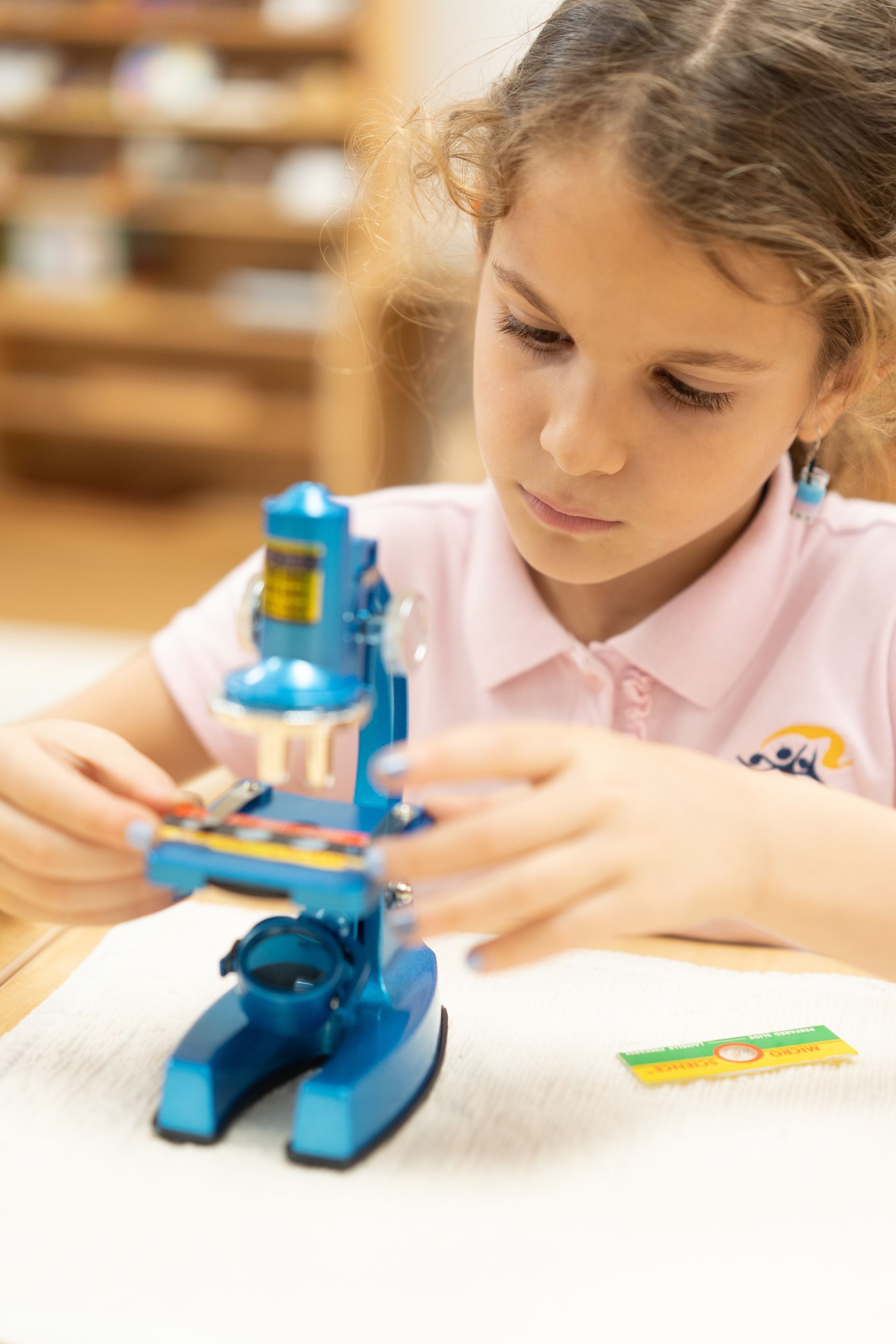
Elementary Program

“The child is now interested in the why, the how, and the when; he asks questions with the idea of mastering the meaning of things.”

— Maria Montessori


During the elementary years, children become more socially aware, intellectually curious, and capable of abstract thinking. The Montessori Elementary classroom is built to meet these developmental needs with structure, freedom, and meaningful work.
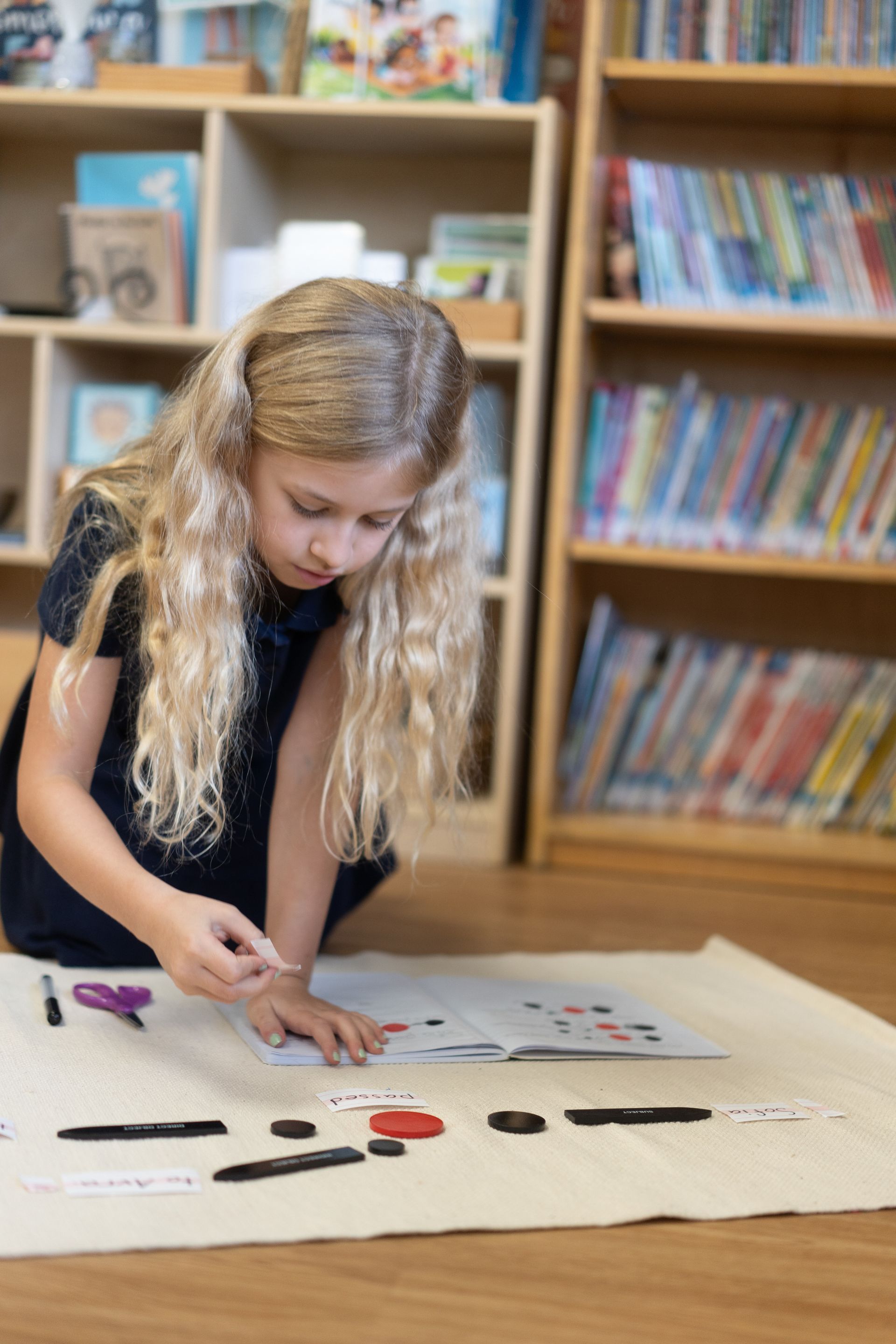
Where imagination expands, and learning becomes a lifelong pursuit.


An Integrated, Interdisciplinary Curriculum


Montessori Elementary offers a broad and integrated curriculum where all subjects connect. Students explore language, math, science, history, geography, art, and music through engaging lessons, hands-on materials, and follow-up work that encourages deeper exploration.


Cosmic Education as a Foundation


Cosmic Education introduces children to the big picture—how the universe began, how life evolved, and how humans shape the world. These stories launch research and allow students to find meaning and purpose in what they learn.


Freedom Within Limits


Students work independently or in collaboration, choosing their tasks with increasing ownership. Montessori guides offer individualized lessons and track each child’s progress, ensuring they are challenged, supported, and guided as needed.


Academic Development in Action


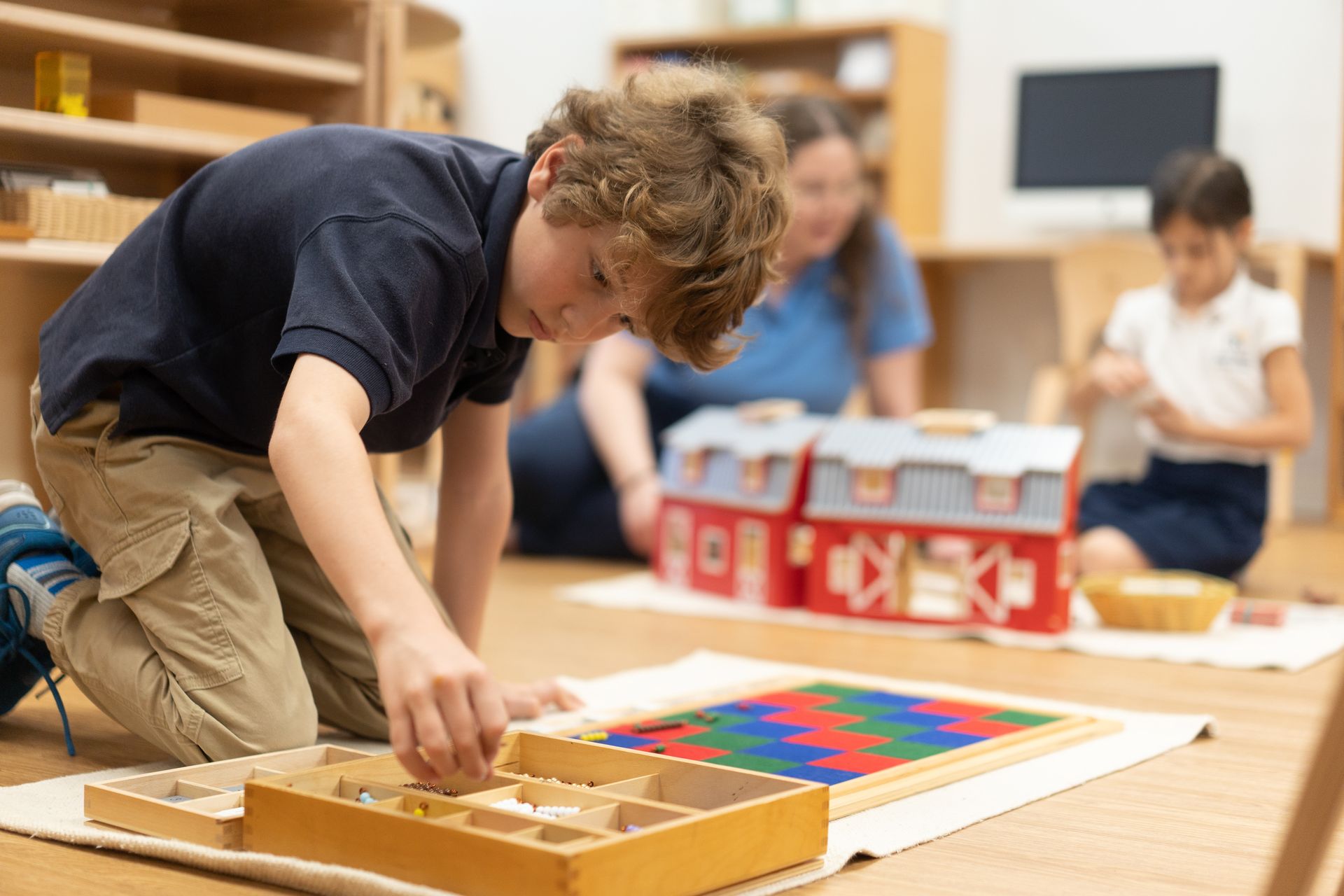
  • Mathematics & Geometry: Children use concrete materials to understand place value, operations, fractions, decimals, and geometric concepts, gradually transitioning to abstraction.


  • Language Arts: Reading and writing are explored through literature, creative writing, spelling, grammar, and research, with an emphasis on comprehension and communication.


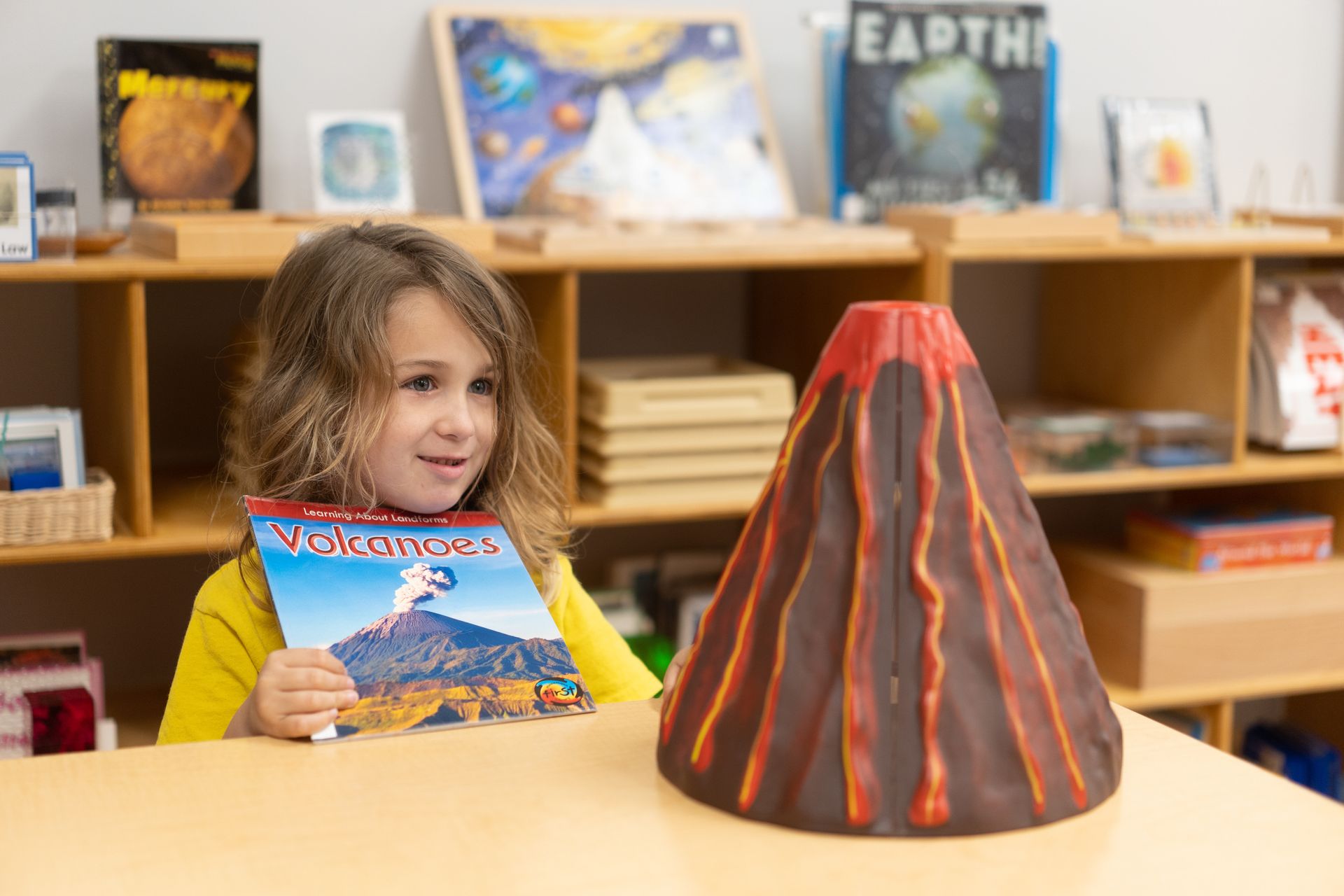
  • Cultural Subjects: Students explore science, history, and geography through observation, experimentation, and storytelling—making connections across time, place, and culture.


  • The Arts: Artistic and musical expression are part of daily life. Children learn to appreciate and create while studying various artists, styles, and instruments.
Social Growth and Grace


Elementary children are highly social. Through projects, discussions, class responsibilities, and formal lessons in grace and courtesy, they learn how to listen, lead, collaborate, and care for others.


Going Out to Learn Beyond the Classroom


Outings are planned that support learning—whether it’s visiting a museum, meeting a scientist, or researching in the local library. These excursions are a natural extension of classroom work and help students develop confidence and real-world skills.


Growth Over Five Years


The Elementary Program spans three to five years, allowing time for children to develop a deep love of learning, strong academic habits, and confidence in their ability to lead, collaborate, and take initiative. They leave the program well-prepared for the next stage of education and life.

Frequently Asked Questions About Our Montessori Elementary Program

  • How Can Montessori Teachers Meet the Needs of So Many Different Children?

    Great teachers help learners get to the point where their minds and hearts are open, leaving them ready to learn. In effective schools, students are not so much motivated by getting good grades as they are by a basic love of learning. As parents know their own children’s learning styles and temperaments, teachers, too, develop this sense of each child’s uniqueness by spending a number of years with the students and their parents. 


    Dr. Montessori believed that teachers should focus on the child as a person, not on the daily lesson plan. Montessori teachers lead children to ask questions, think for themselves, explore, investigate, and discover. Their ultimate objective is to help their students to learn independently and retain the curiosity, creativity, and intelligence with which they were born. As we said in an earlier chapter, Montes-sori teachers don’t simply present lessons; they are facilitators, mentors, coaches, and guides. 


    Traditionally, teachers have told us that they “teach students the basic facts and skills that they will need to succeed in the world.” Studies show that in many classrooms, a substantial portion of the day is spent on discipline and classroom management. 


    Normally, Montessori teachers will not spend much time teaching lessons to the whole class. Their primary role is to prepare and maintain the physical, intellectual, and social/emotional environment within which the children will work. A key aspect of this is the selection of intriguing and developmentally appropriate learning activities to meet the needs and interests of each child in the class. Montessori teachers usually present lessons to small groups of children at one time and limit lessons to brief and very clear presentations. The goal is to give the children just enough to capture their attention and spark their interest, intriguing them enough that they will come back on their own to work with the learning materials. 


    Montessori teachers closely monitor their students’ progress. Because they normally work with each child for two or three years, they get to know their students’ strengths and weaknesses, interests, and personalities extremely well. Montessori teachers often use the children’s interests to enrich the curriculum and provide alternate avenues for accomplishment and success.


  • Why Is a Montessori Classroom Called a “Children’s House”?

    Dr. Montessori’s focus on the “whole child” led her to develop a very different sort of school from the traditional teacher-centered classroom. To emphasize this difference, she named her first school the “Casa dei Bambini”or the “Children’s House”. 


    The Montessori classroom is not the domain of the adults in charge; it is, instead, a carefully prepared environment designed to facilitate the development of the children’s independence and sense of personal empowerment. This is a children’s community. They move freely within it, selecting work that captures their interest. In a very real sense, even very small children are responsible for the care of their own child-sized environment. When they are hungry, they prepare their own snacks and drinks. They go to the bathroom without assistance. When something spills, they help each other carefully clean up. 


    Four generations of parents have been amazed to see small children in Montessori classrooms cut raw fruits and vegetables, sweep and dust, carry pitchers of water, and pour liquids with barely a drop spilled. The children normally go about their work so calmly and purposely that it is clear to even the casual observer that they are the masters in this place: The “Children’s House”.


  • What Do Montessori Schools Mean by the Term “Normalization?

    “Normalization” is a Montessori term that describes the process that takes place in Montessori classrooms around the world, in which young children, who typically have a short attention span, learn to focus their intelligence, concentrate their energies for long periods of time, and take tremendous satisfaction from their work. In his book, Maria Montessori: Her Life and Work, E.M. Standing described the following characteristics of normalization in the child between the age of three and six: 

    • A love of order 
    • A love of work 
    • Profound spontaneous concentration 
    • Attachment to reality 
    • Love of silence and of working alone 
    • Sublimation of the possessive instinct 
    • Obedience 
    • Independence and initiative 
    • Spontaneous self-discipline 
    • Joy; and 
    • The power to act from real choice and not just from idle curiosity. 
  • Are There Any Tests in Montessori Programs?

    Montessori teachers carefully observe their students at work. They give their students informal, individual oral exams or have the children demonstrate what they have learned by either teaching a lesson to another child or by giving a formal presentation. The children also take and prepare their own written tests to ad-minister to their friends. Montessori children usually don’t think of assessment techniques as tests so much as challenges. Students are normally working toward mastery rather than a standard letter grade scheme. 


    Standardized Tests: Very few Montes-sori schools test children under the first or second grades; however, most Montessori schools regularly give elementary students quizzes on the concepts and skills that they have been studying. Many schools have their older students take annual standardized tests. 


    While Montessori students tend to score very well, Montessori educators are deeply concerned that many standardized tests are inaccurate, misleading, and stressful for children. Good teachers, who work with the same children for three years and carefully observe their work, know far more about their progress than any paper-and-pencil test can reveal. 


    The ultimate problem with standardized tests is that they have often been misunderstood, misinterpreted, and poorly used to pressure teachers and students to perform at higher standards. Although standardized tests may not offer a terribly accurate measure of a child’s basic skills and knowledge, in most countries test-taking skills are just another Practical Life lesson that children need to master. 


  • Is Montessori Opposed to Fantasy and Creativity?

    Fantasy and creativity are important aspects of a Montessori child’s experience. Montessori classrooms incorporate art, music, dance, and creative drama throughout the curriculum. Imagination plays a central role, as children explore how the natural world works, visualize other cultures and ancient civilizations, and search for creative solutions to real-life problems. In Montessori schools, the Arts are normally integrated into the rest of the curriculum. 

  • What’s the Big Deal about Freedom And Independence in Montessori?

    Children touch and manipulate everything in their environment. In a sense, the human mind is handmade, because through movement and touch, the child explores, manipulates, and builds a storehouse of impressions about the physical world around her. Children learn best by doing, and this requires movement and spontaneous investigation. 


    Montessori children are free to move about, working alone or with others at will. They may select any activity and work with it as long as they wish, so long as they do not disturb anyone or damage anything, and as long as they put it back where it belongs when they are finished. 


    Many exercises, especially at the early childhood level, are designed to draw children’s attention to the sensory properties of objects within their environment: size, shape, color, texture, weight, smell, sound, etc. Gradually, they learn to pay attention, seeing more clearly small details in the things around them. They have begun to observe and appreciate their environment. This is a key in helping children discover how to learn. 


    Freedom is a second critical issue as children begin to explore. Our goal is less to teach them facts and concepts, but rather to help them to fall in love with the process of focusing their complete attention on something and mastering its challenge with enthusiasm. Work assigned by adults rarely results in such enthusiasm and interest as does work that children freely choose for themselves. 


    The prepared environment of the Montessori class is a learning laboratory in which children are allowed to explore, discover, and select their own work. The independence that the children gain is not only empowering on a social and emotional basis, but it is also intrinsically involved with helping them become comfortable and confident in their ability to master the environment, ask questions, puzzle out the answer, and learn without needing to be “spoon-fed” by an adult.

  • Does Montessori Teach Religion?

    Except for those schools that are associated with a particular religious community, Montessori does not teach religion. Many Montessori schools celebrate holidays, such as Christmas, Hannukah, and Chinese New Year, which are religious in origin, but which can be experienced on a cultural level as special days of family feasting, merriment, and wonder. 


    The young child rarely catches more than a glimmer of the religious meaning behind the celebration. Our goal is to focus on how children would normally experience each festival within their culture: the special foods, songs, dances, games, stories, presents — a potpourri of experiences aimed at all the senses of a young child. 


    On the other hand, one of our fundamental aims is the inspiration of the child’s heart. While Montessori does not teach religion, we do present the great moral and spiritual themes, such as love, kindness, joy, and confidence in the fundamental goodness of life in simple ways that encourage the child to begin the journey toward being fully alive and fully human. Everything is intended to nurture within the child a sense of joy and appreciation of life. 


Reviews

Our Reviews

"I absolutely love Miami Shores Montessori School and I can't recommend this great school. My daughter joined the school during the pandemic and the way they managed it was flawless. The Head of school and all the teachers are fantastic and I truly appreciate all the care, dedication and warmth they have given to my daughter. There is always great communication and connection with parents and the school. Keep on doing great work!! The community of Miami Shores greatly appreciates and needs the level of education and care you all provide!"


— The Perez Family


"Miami Shores Montessori has enriched our children's and family's lives in a multitude of ways. All three of our children began attending as toddlers and have been growing with the school through the lower elementary program. The school is a sanctuary of safety, caring, thoughtfulness, attention, and learning. Ms. Sylvia is an incredible leader and professional who tends to her teachers, the campus, and the students with the utmost care. Miami Shores Montessori has been an incredible gift in our lives and we cherish every moment our children are a part of it. There's no better gift than to have your children a part of this school and to experience it as a family alongside them."


— The Lenahan Family

If you think your child would thrive in a Montessori environment, give us a call or schedule a tour. We would love for you to visit our school and learn more.